
The Historical Context of the Panchen Lama
The Panchen Lama holds a central position within Tibetan Buddhism, ranking just below the Dalai Lama in spiritual authority within the Gelug school. The title itself emerged in the 17th century during the consolidation of religious and political structures in Tibet. The term “Panchen” is a combination of two words: pandita, meaning scholar, and chenpo, meaning great. This reflects the role’s traditional association with scholarship, teaching, and monastic leadership.
Historically, the Panchen Lama has been closely linked with Tashilhunpo Monastery in Shigatse, one of the most significant religious institutions in Tibet. The relationship between the Panchen Lama and the Dalai Lama is often described as reciprocal. Each plays a role in identifying the reincarnation of the other, which reinforces continuity in religious leadership. This system of recognition, based on Tibetan Buddhist beliefs about reincarnation, has remained a defining feature of the region’s spiritual governance.
Over time, the Panchen Lama also came to occupy a political role, particularly during periods when the Dalai Lama was a minor or absent. This dual religious and political significance has made the position especially sensitive in the context of modern state governance.
The Controversy Begins
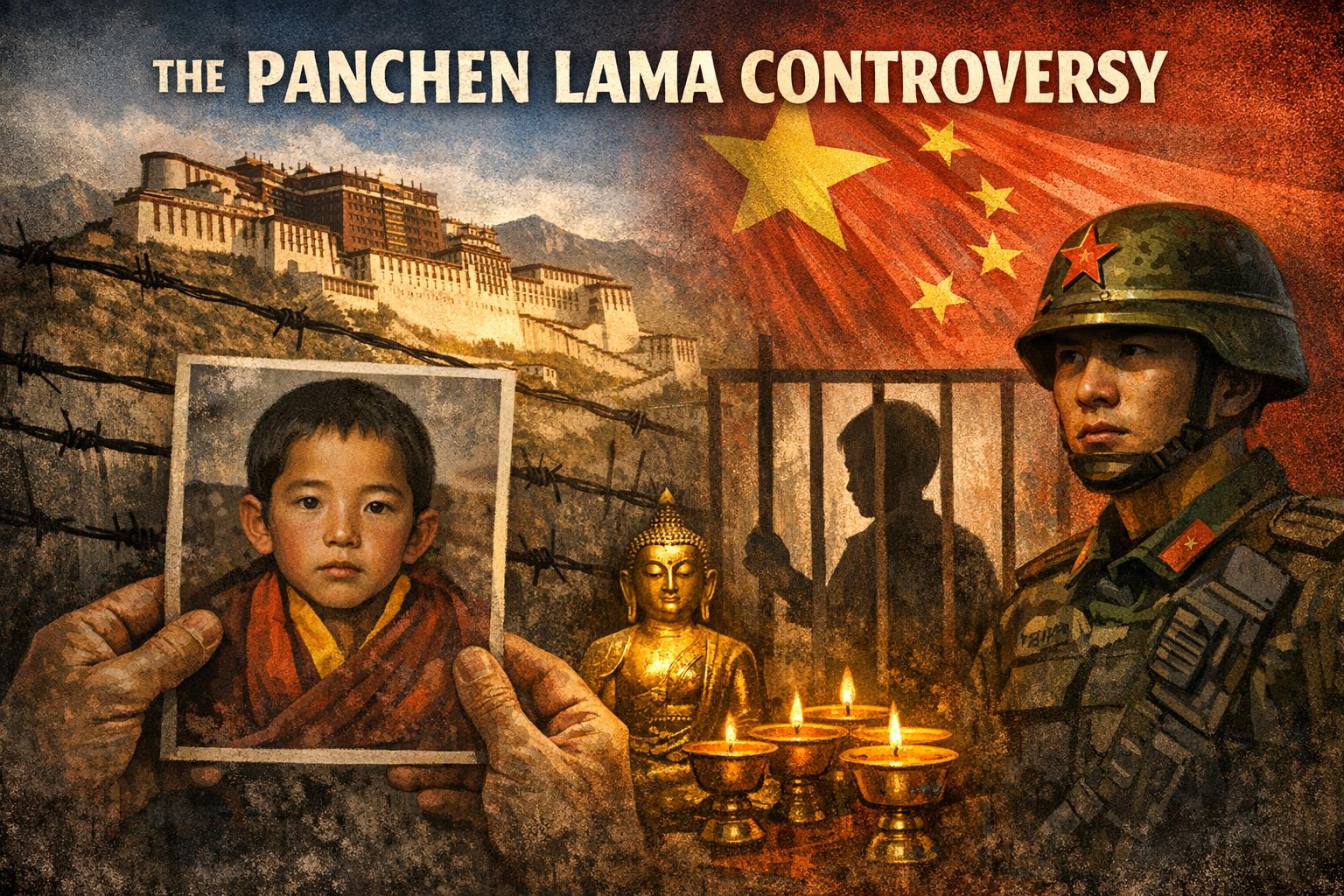
The current controversy surrounding the Panchen Lama can be traced to events in 1995. Following the death of the 10th Panchen Lama in 1989, the process of identifying his reincarnation began according to traditional methods. These typically involve consultations with senior lamas, interpretation of signs, and spiritual rituals.
On May 14, 1995, the 14th Dalai Lama announced that a six-year-old boy, Gedhun Choekyi Nyima, had been recognized as the 11th Panchen Lama. This recognition was consistent with established religious practices and was accepted by many Tibetans both inside and outside Tibet.
However, within days of the announcement, Chinese authorities intervened. Gedhun Choekyi Nyima and his family were taken into custody, and since that time, there has been no confirmed public information about his whereabouts. Chinese officials have described him as living a normal life under state protection, but independent verification has not been possible.
Later that same year, the Chinese government organized its own selection process and announced Gyaincain Norbu as the 11th Panchen Lama. This decision relied on a historical method known as the “Golden Urn,” a lottery system introduced during the Qing dynasty. While this method has precedent, its use in this case was viewed by many as politically driven.
China’s Influence in Tibetan Buddhism
The appointment of Gyaincain Norbu reflects a broader policy approach by the Chinese government toward religion, particularly in regions with distinct cultural and spiritual traditions. Tibetan Buddhism, with its established hierarchy and influence among the population, is seen as an area where governance and religious authority can intersect.
By taking an active role in recognizing religious figures, Chinese authorities seek to ensure that key institutions operate within the framework of state policy. This includes regulation of monasteries, oversight of religious education, and management of reincarnation processes. In recent decades, regulations have formalized the requirement that reincarnations of high-ranking lamas receive government approval.
This approach is not limited to the Panchen Lama alone. It extends to broader efforts aimed at integrating Tibetan Buddhism into administrative structures. The long-term implications are particularly significant in relation to the future succession of the Dalai Lama, as the Panchen Lama traditionally plays a role in that process.
Gyaincain Norbu has since assumed public religious duties within China, including participation in state-approved ceremonies and advisory roles. His recognition by Chinese authorities provides a version of institutional continuity that aligns with official policies, though it remains contested among many Tibetans.
International Reactions
The disappearance of Gedhun Choekyi Nyima has drawn consistent attention from international organizations, governments, and advocacy groups. Concerns have focused on both the individual case and the broader implications for religious freedom.
Human rights organizations have repeatedly called for transparency regarding his status and access by independent observers. Several governments have raised the issue in diplomatic discussions, emphasizing the importance of protecting cultural and religious rights.
China has maintained that the matter is an internal issue and has rejected external interference. Statements from officials have emphasized sovereignty and stability, while also asserting that Gedhun Choekyi Nyima’s privacy must be respected. However, the lack of independent verification has continued to fuel skepticism.
Beyond governments, the issue has been discussed in academic and policy contexts as an example of tension between traditional religious systems and modern state authority. It has also become a reference point in discussions about minority rights and cultural preservation.
Continuing Debate
The Panchen Lama controversy remains unresolved and continues to influence both Tibetan Buddhism and international discourse. At its core is a disagreement over authority: whether religious recognition should remain within traditional frameworks or be subject to state oversight.
For many Tibetans, the recognition of Gedhun Choekyi Nyima by the Dalai Lama holds spiritual legitimacy, regardless of his absence. At the same time, Gyaincain Norbu functions as the officially recognized Panchen Lama within China, creating a parallel structure of authority.
The situation has further implications for the future. Because the Panchen Lama plays a role in identifying the next Dalai Lama, questions about legitimacy are likely to persist and possibly intensify. This creates a complex scenario in which religious tradition, political authority, and international concerns intersect.
In summary, the Panchen Lama controversy illustrates a broader tension between established religious practices and modern governance. It highlights differing perspectives on legitimacy, authority, and cultural autonomy. As long as these issues remain unresolved, the topic is likely to continue shaping discussions about Tibet, religion, and state power.