
The Historical Context
The history of Tibet reflects a long interaction between political authority, religious institutions, and regional dynamics in Inner Asia. For centuries, Tibet maintained systems of governance that combined monastic influence with aristocratic administration, while also entering into varying forms of relationship with neighboring powers, including different Chinese dynasties. These relationships ranged from military confrontation to patron-priest alliances, and at times indirect administrative oversight. Interpretations of these relationships remain contested, forming a central point of debate in modern discussions.
In the mid-20th century, the incorporation of Tibet into the People’s Republic of China marked a decisive turning point. With this change came not only administrative restructuring but also an effort to reinterpret Tibet’s past in ways that aligned with the political objectives of the Chinese state. Understanding these developments requires attention to both historical records and the mechanisms through which historical narratives are constructed and disseminated.
The Emergence of Chinese Propaganda
Following the establishment of Chinese control over Tibet in the 1950s, state-led information campaigns were developed to present a consistent account of Tibet’s status. Central to these efforts was the assertion that Tibet had been an integral part of China for centuries. This claim was framed through selective readings of historical events, including references to earlier imperial-era relationships.
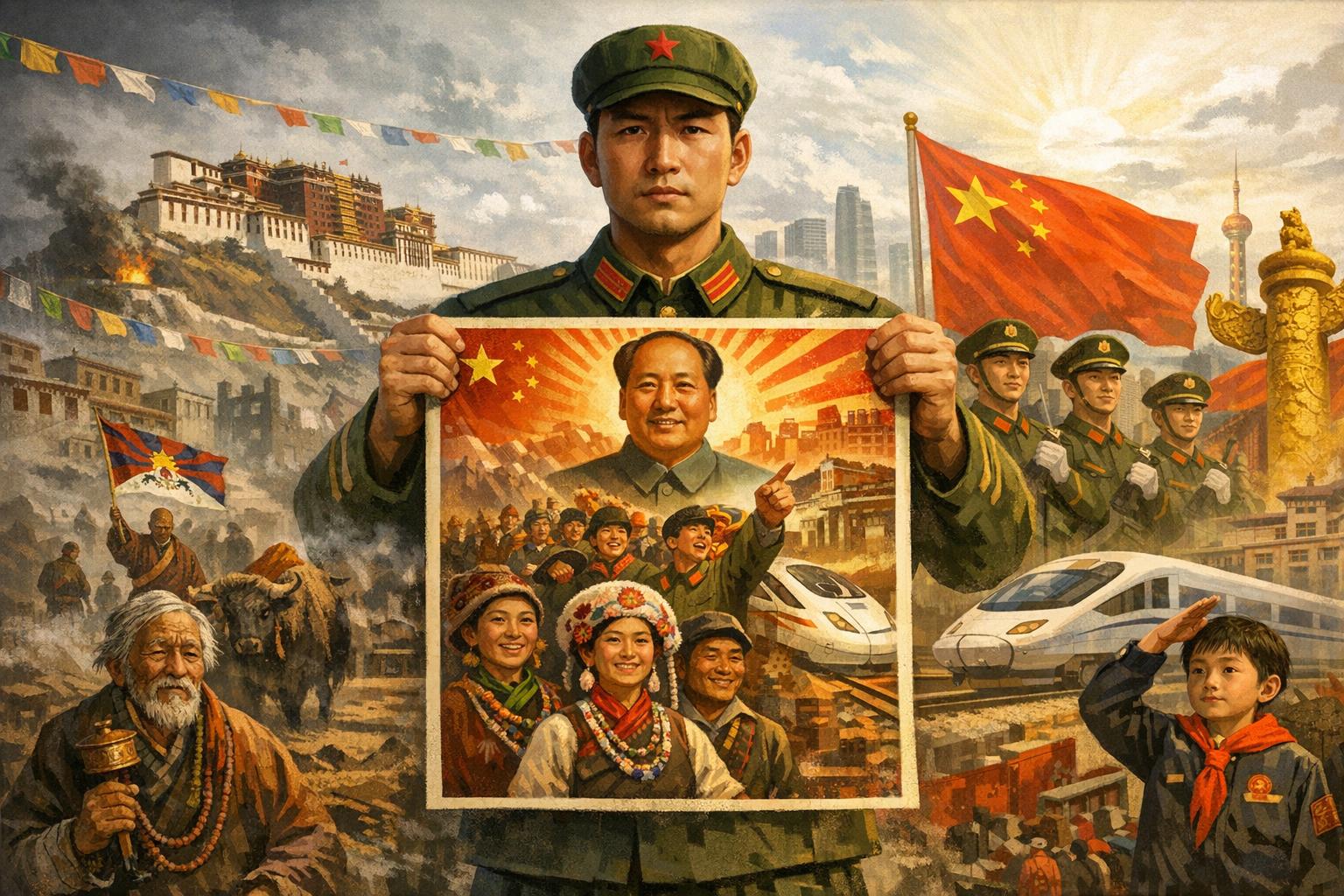
The concept of the “peaceful liberation” of Tibet became a foundational element of this narrative. Official accounts portrayed Chinese entry into Tibet as a necessary step to end what was described as a feudal system and to introduce modernization. This framing positioned the Chinese Communist Party as a force of social progress, emphasizing infrastructure development, economic reforms, and expanded access to education and healthcare. At the same time, alternative interpretations—particularly those emphasizing Tibetan autonomy or independence—were characterized as inaccurate or politically motivated.
Control over communication channels allowed the Chinese government to standardize this narrative across multiple platforms. As a result, a coherent version of events was consistently presented to both domestic and international audiences.
Media and Educational Channels
State media has served as a primary vehicle for shaping public understanding of Tibet. Newspapers, television broadcasts, films, and more recently digital platforms have repeated themes of liberation, development, and national unity. Visual imagery often complements these themes, depicting infrastructure projects, urban expansion, and cultural performances that align with state-approved representations of Tibetan life.
Educational systems reinforce these narratives through textbooks and curricula that present Tibet as historically connected to China. These materials typically emphasize political unity while minimizing or reframing periods of Tibetan self-governance. Over time, this approach has contributed to a standardized understanding among Chinese citizens, many of whom have limited exposure to alternative historical interpretations.
Language policy also plays a role. The promotion of Mandarin Chinese in Tibetan regions, alongside the regulation of Tibetan-language instruction, influences how history is taught and understood. While Tibetan language and culture are officially recognized, the structure of education often prioritizes integration into broader national frameworks.
International Influence
Beyond its borders, China has adopted a range of strategies to influence how Tibet is understood globally. Economic partnerships, cultural exchanges, and academic collaborations have provided channels through which China can present its perspective. Research institutions and universities may receive funding for programs that include the study of Tibet, sometimes shaping the direction and emphasis of academic work.
Media engagement is another important dimension. Chinese state media outlets produce content in multiple languages, aiming to reach international audiences with narratives consistent with official positions. In some cases, access to Tibetan regions for foreign journalists and researchers is restricted, which can limit independent reporting and increase reliance on officially sanctioned information.
Diplomatic efforts also contribute to shaping discourse. Governments and international organizations may face political or economic pressure when addressing Tibet-related issues. As a result, public statements and policy positions on Tibet often reflect broader considerations in foreign relations with China.
The Effects on Tibetan Identity
Efforts to define Tibet within a Chinese national framework have implications for cultural and social identity. Official narratives emphasize unity among China’s diverse ethnic groups, including Tibetans, portraying them as part of a shared national community. Policies promoting economic development and infrastructure investment are often presented as benefiting all groups equally, reinforcing this perspective.
At the same time, the preservation of Tibetan cultural practices, language, and religious expression remains a subject of ongoing negotiation. While cultural festivals and certain traditions are supported and publicly displayed, other forms of expression—particularly those linked to political or religious leadership outside state structures—may face restrictions.
These dynamics create a complex environment in which identity is shaped by both state policy and local practices. Many Tibetans continue to maintain distinct cultural traditions, including religious observance centered on Tibetan Buddhism. The interaction between official narratives and lived experience contributes to differing views within Tibetan communities themselves.
Contemporary Repercussions
The differing interpretations of Tibet’s history and status continue to influence present-day developments. Human rights concerns, including issues related to religious freedom, language use, and cultural preservation, are frequently raised by international observers. Chinese authorities, in response, emphasize economic progress and improvements in living standards as evidence of positive governance.
Discussions about Tibet also intersect with broader geopolitical considerations. Countries may weigh human rights concerns against economic and strategic interests when forming their positions. This can lead to cautious or limited engagement on the issue in international forums.
Within China, public discourse on Tibet remains largely aligned with official narratives, though global information flows have introduced some diversity of perspectives. Outside China, academic and policy debates continue to examine historical sources, political developments, and cultural changes in an effort to reach a more comprehensive understanding.
Conclusion
The role of state-led messaging in shaping interpretations of Tibetan history illustrates the broader impact of information control in modern political contexts. By promoting a specific narrative through media, education, and international engagement, the Chinese government has influenced how Tibet is perceived both domestically and abroad. At the same time, alternative perspectives persist, supported by historical research and the experiences of Tibetan communities.
The ongoing discussion reflects the complexity of reconciling differing historical accounts and political viewpoints. Careful examination of sources, awareness of context, and openness to multiple perspectives remain important for analyzing the relationship between Tibet and China.