
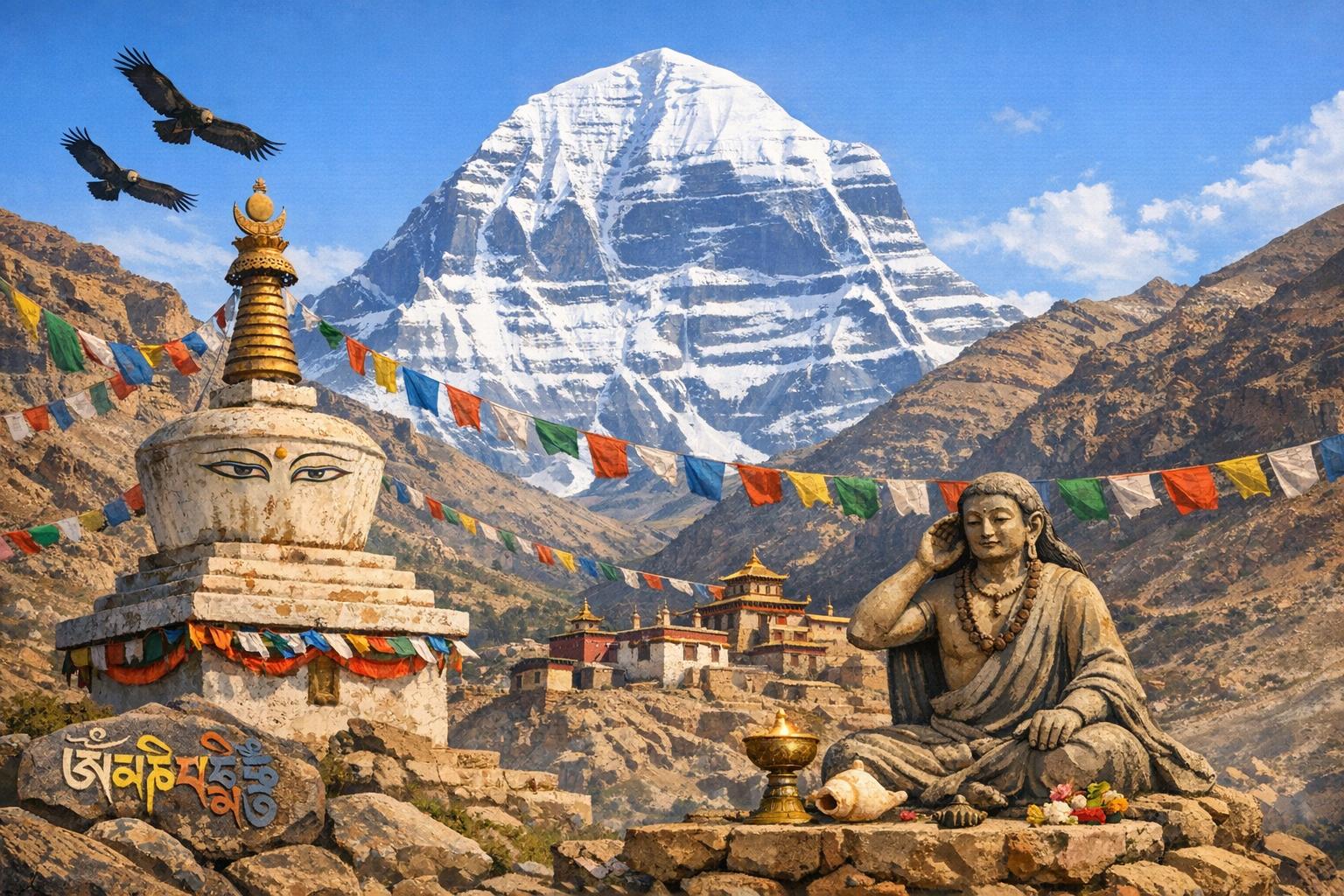
Mount Kailash: A Sacred Landmark in Tibetan Culture
Mount Kailash is a prominent peak in the Transhimalaya range of western Tibet, rising to approximately 6,638 meters (21,778 feet). Despite not being among the highest mountains in the Himalayan system, it occupies a distinctive position due to its enduring religious and cultural importance. Situated near the sources of several major rivers in Asia, including the Indus, Sutlej, Brahmaputra, and Karnali, the mountain has long been associated with themes of origin, balance, and cosmic order. Its unique pyramid-like shape and relatively isolated position further contribute to its recognition as a geographical and spiritual landmark.
Spiritual Significance
Within Tibetan culture and across much of South Asia, Mount Kailash is regarded as a sacred entity rather than merely a physical formation. Its importance is rooted in layered religious traditions that have developed over centuries. For many communities, the mountain represents a point of connection between the physical and metaphysical worlds.
In Tibetan Buddhism, the mountain is identified with the cosmic axis, sometimes described as the center of the universe in symbolic cosmology. Similarly, in Hindu traditions, it is understood as the abode of Shiva, where he resides in a state of meditation. Jain and Bon traditions also attach deep meaning to the site, making Kailash a rare example of a shared sacred geography across multiple religions.
Buddhist Connection
In Tibetan Buddhist belief, Mount Kailash is associated with Demchok (Chakrasamvara), a deity symbolizing the union of wisdom and compassion. This association highlights the mountain’s role not just as a place of reverence but as a representation of philosophical ideals central to Buddhist practice.
The mountain also appears in traditional narratives concerning Milarepa, one of Tibet’s most significant yogis. According to these accounts, Milarepa engaged in a spiritual contest with Naro Bon-chung, a practitioner of the Bon tradition. Milarepa’s victory is interpreted as a symbolic affirmation of Buddhist teachings within the region. The story continues to be referenced in oral traditions and contributes to the mountain’s layered religious identity.
Hindu and Jain Perspectives
For Hindus, Mount Kailash holds primary importance as the dwelling place of Lord Shiva and his consort Parvati. In this context, the mountain is not simply symbolic but is regarded as an actual site of divine presence. Hindu cosmology often links Kailash with Mount Meru, the mythological center of the universe, reinforcing its perceived centrality in spiritual geography.
Jain traditions identify the mountain as the location where Rishabhadeva, the first Tirthankara, attained moksha, or liberation from the cycle of rebirth. This association makes Kailash a destination of reflection and reverence within Jain pilgrimage practices.
The Bon religion, which predates Buddhism in Tibet, also considers the mountain sacred. In Bon tradition, Kailash is associated with spiritual power and ancestral significance, further broadening the cultural framework within which the mountain is understood.
The Pilgrimage: A Journey of Faith
Pilgrimage to Mount Kailash is a central practice shared across these traditions. Rather than ascending the peak, which is strictly prohibited, pilgrims engage in a ritual circumambulation known as the Kora. This journey, covering approximately 52 kilometers (32 miles), is undertaken on foot and typically completed over several days.
The act of walking around the mountain is understood as a form of spiritual discipline. Pilgrims often perform the journey in a clockwise direction, though followers of the Bon tradition traditionally walk counterclockwise. This directional difference highlights the diversity of practices while maintaining a shared reverence for the site.
The Path of Enlightenment
The Kora is considered both physically and spiritually demanding. The route reaches elevations above 5,600 meters (18,000 feet), where reduced oxygen levels and variable weather conditions present significant challenges. Despite these difficulties, thousands of pilgrims undertake the journey each year.
For many, completing a single circuit of the mountain is believed to cleanse accumulated negative actions. Some pilgrims aspire to complete multiple circuits, with particular spiritual merit attributed to performing 13 or even 108 rounds. Others undertake full-body prostrations along the entire route, extending the journey over several weeks.
The experience is often described as a combination of endurance, ritual, and introspection. Walking the Kora is not seen solely as a physical act but as a process that integrates movement, intention, and belief.
Geographical and Environmental Context
Mount Kailash is located in a remote region of the Tibetan Plateau, characterized by high altitude, low temperatures, and limited vegetation. The surrounding landscape includes expansive plains, glacial formations, and nearby lakes such as Lake Manasarovar and Lake Rakshastal, both of which hold additional religious significance.
The environmental conditions contribute to the mountain’s relative isolation. Infrastructure in the region remains limited, and access typically involves long-distance travel over rugged terrain. These factors have played a role in preserving the area’s natural state.
The mountain’s four distinct faces are often described as aligned with the cardinal directions, reinforcing its symbolic association with order and balance. Seasonal variations in snow and light can alter its appearance, adding to its visual and cultural prominence.
Preservation of Sacred Space
One of the defining features of Mount Kailash is that it remains unclimbed. Unlike many other peaks in the Himalayas and Transhimalaya, climbing Kailash is prohibited out of respect for its sacred status. This prohibition is widely observed and supported by local authorities as well as religious communities.
The absence of mountaineering activity has contributed to the preservation of both the physical environment and the symbolic integrity of the site. The cultural consensus surrounding its protection reflects a broader perspective in which natural features are treated as integral to spiritual practice rather than as objects for conquest or recreation.
Efforts to manage pilgrimage activity have also focused on minimizing environmental impact. While the number of visitors has increased over time, regulations are in place to reduce waste and maintain the area’s ecological balance.
Conclusion
Mount Kailash occupies a unique position at the intersection of geography, religion, and cultural memory. Its significance extends beyond national or regional boundaries, encompassing a wide range of beliefs and practices that have persisted across centuries. The mountain’s role as a pilgrimage destination, a symbolic center, and a protected landscape illustrates how natural features can acquire enduring cultural meaning.
Its continued preservation reflects a shared recognition of its importance, not only as a physical landmark but as a focal point for spiritual reflection. Across different traditions, Mount Kailash remains a site where belief, environment, and tradition converge in a sustained and meaningful way.