
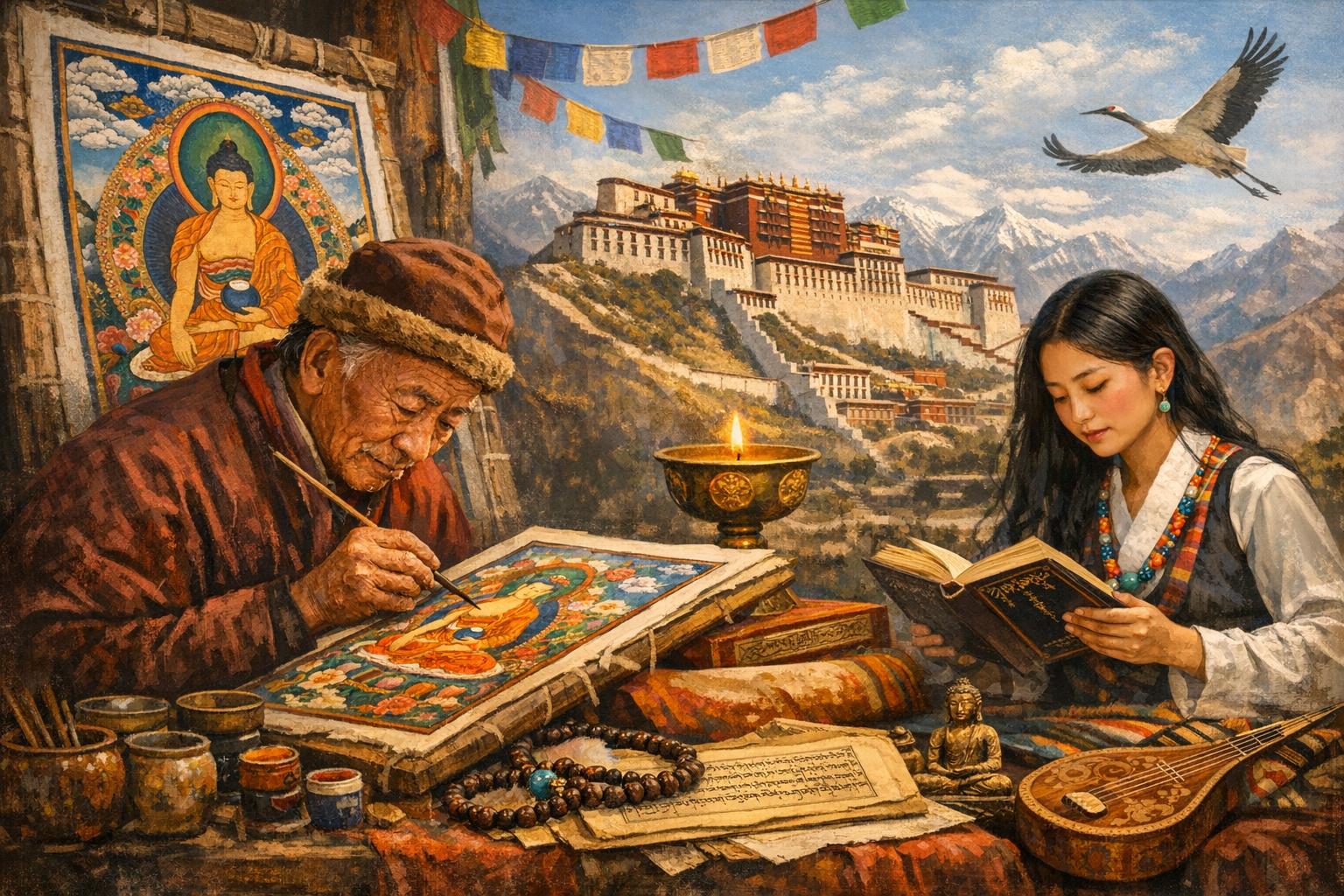
The Role of Art in Preserving Tibetan Identity
Tibetan art functions as a primary vehicle for expressing and maintaining cultural and religious identity. Rooted in Tibetan Buddhism, artistic traditions integrate symbolism, ritual, and craftsmanship into forms that communicate shared values and historical continuity. These works are not created solely for aesthetic appreciation; they are embedded within daily and ceremonial life, reinforcing collective memory and belief systems. From monastery murals to portable objects used in private homes, Tibetan art provides both visual narratives and instructional frameworks that sustain cultural knowledge across generations.
Art in Tibet has historically been shaped by religious institutions, which have acted as centers for artistic production and training. Monasteries often served as workshops where artists learned standardized iconography and methods. This institutional structure ensured consistency in visual language, allowing viewers to interpret symbols and figures with a shared understanding. The result is a cohesive artistic tradition that maintains continuity even as it evolves.
Thangka Paintings
Thangka paintings represent one of the most recognizable forms of Tibetan art. These scroll paintings are typically created on cotton or silk and are designed to be portable, allowing them to be rolled and transported for teaching or ritual use. The content of thangkas is highly structured, depicting Buddhist deities, historical figures, cosmological diagrams, or mandalas according to precise guidelines.
The creation of a thangka involves careful preparation and adherence to symbolic proportions. Artists follow detailed instructions regarding posture, color, and composition, ensuring that each element conveys specific meanings. For example, colors are not chosen arbitrarily but correspond to particular qualities or aspects of enlightenment. This precision allows thangkas to serve as tools for meditation, where practitioners focus on visual details to deepen their understanding of Buddhist teachings.
Beyond their ritual function, thangkas also act as educational instruments. They provide visual representations of complex philosophical concepts that might otherwise remain abstract. In both monastic and domestic settings, these artworks help communicate religious narratives and ethical principles, reinforcing shared beliefs within the community.
Sculpture and Mandalas
In addition to paintings, Tibetan art includes a wide range of sculptural forms. Statues of deities and spiritual teachers are commonly found in temples and homes, often crafted from materials such as bronze, clay, or wood. These sculptures are not merely decorative objects; they are treated as vessels that embody spiritual presence. Ritual practices such as offerings and prayers are conducted in relation to these figures, integrating art directly into religious life.
Mandalas represent another important artistic form, characterized by geometric arrangements that symbolize the universe in Buddhist cosmology. Created using materials ranging from paint to colored sand, mandalas illustrate the structure of spiritual realms and the path toward enlightenment. Sand mandalas, in particular, emphasize impermanence, as they are carefully dismantled after completion. This process reinforces key philosophical teachings while also demonstrating the technical skill and discipline required of the कलाकार.
Together, sculpture and mandalas expand the scope of Tibetan art beyond two-dimensional representation, offering immersive and interactive experiences that support both contemplation and ritual practice.
The Communal Nature of Artistic Transmission
A defining feature of Tibetan art is its communal method of transmission. Skills and knowledge are passed down through apprenticeships, where experienced artists train students in both technique and symbolic interpretation. This educational model prioritizes continuity over individual innovation, ensuring that artistic standards remain aligned with established traditions.
The transmission process extends beyond technical instruction. It includes the teaching of धार्मिक principles, cultural values, and historical context, all of which inform artistic production. In this way, learning art becomes a comprehensive engagement with Tibetan identity itself.
Tibetan communities in exile have continued this tradition by establishing cultural centers and schools dedicated to preserving artistic practices. These institutions play a critical role in maintaining continuity under changing circumstances, providing structured environments where younger generations can learn skills that might otherwise decline.
The Influence of Literature on Tibetan Identity
Literature complements visual art by preserving linguistic, philosophical, and historical dimensions of Tibetan culture. It encompasses both written texts and oral traditions, each contributing to the continuity of knowledge and identity. Tibetan literature has historically been closely linked to religious study, with monasteries functioning as centers for textual preservation and interpretation.
Religious texts, including the Tibetan Buddhist canon, hold a central place in this literary tradition. These writings contain teachings attributed to the Buddha as well as commentaries by Tibetan scholars. They provide a framework for understanding ethical conduct, metaphysics, and spiritual practice. The study and recitation of these texts reinforce shared values and contribute to cultural cohesion.
Oral traditions remain equally significant. Stories, proverbs, and songs are transmitted through spoken language, often in communal settings. These narratives encode historical experiences, social norms, and moral lessons. Because oral traditions can adapt to changing circumstances, they serve as flexible tools for maintaining identity even in contexts where written materials are less accessible.
The Modern Landscape of Tibetan Art and Literature
Contemporary developments have introduced new forms and platforms for Tibetan cultural expression. Artists and writers are increasingly engaging with digital media, film, and print publishing to reach broader audiences. While traditional themes and symbols remain central, these mediums allow for the exploration of modern experiences, including migration, identity negotiation, and cultural preservation.
Digitization projects have become an important aspect of cultural conservation. Ancient manuscripts, artworks, and archival materials are being converted into digital formats, enabling wider access and reducing the risk of loss. These efforts often involve collaboration between Tibetan organizations and international institutions, reflecting a shared recognition of the importance of preserving cultural heritage.
At the same time, contemporary creators are contributing new perspectives to Tibetan art and literature. By incorporating modern techniques and themes, they expand the scope of cultural expression while maintaining connections to traditional foundations. This balance between continuity and adaptation is a defining feature of the current cultural landscape.
Challenges and Opportunities
The preservation of Tibetan art and literature faces a range of challenges. Political constraints, economic limitations, and the pressures of globalization can affect the transmission of cultural practices. In some cases, younger generations may have limited access to traditional forms of education, reducing opportunities to learn established techniques and narratives.
However, these challenges are accompanied by opportunities for innovation. Increased global interest in Tibetan culture has created platforms for cultural exchange and support. Exhibitions, publications, and digital initiatives allow Tibetan artists and writers to present their work to international audiences, raising awareness and fostering appreciation.
Technological tools also provide new methods for documentation and teaching. Online resources, virtual exhibitions, and digital archives can supplement traditional forms of instruction, ensuring that knowledge remains accessible even in dispersed communities.
Continuity Through Expression
Art and literature together form a comprehensive system for preserving Tibetan identity. Visual forms communicate symbolic and religious meanings, while literary traditions convey language, philosophy, and narrative history. Both rely on processes of transmission that emphasize continuity, community involvement, and adaptation.
Through ongoing practice and innovation, Tibetan art and literature continue to sustain cultural identity across different contexts. They remain central to the ways in which Tibetan communities understand their past, engage with the present, and plan for the future.