
Historical Context
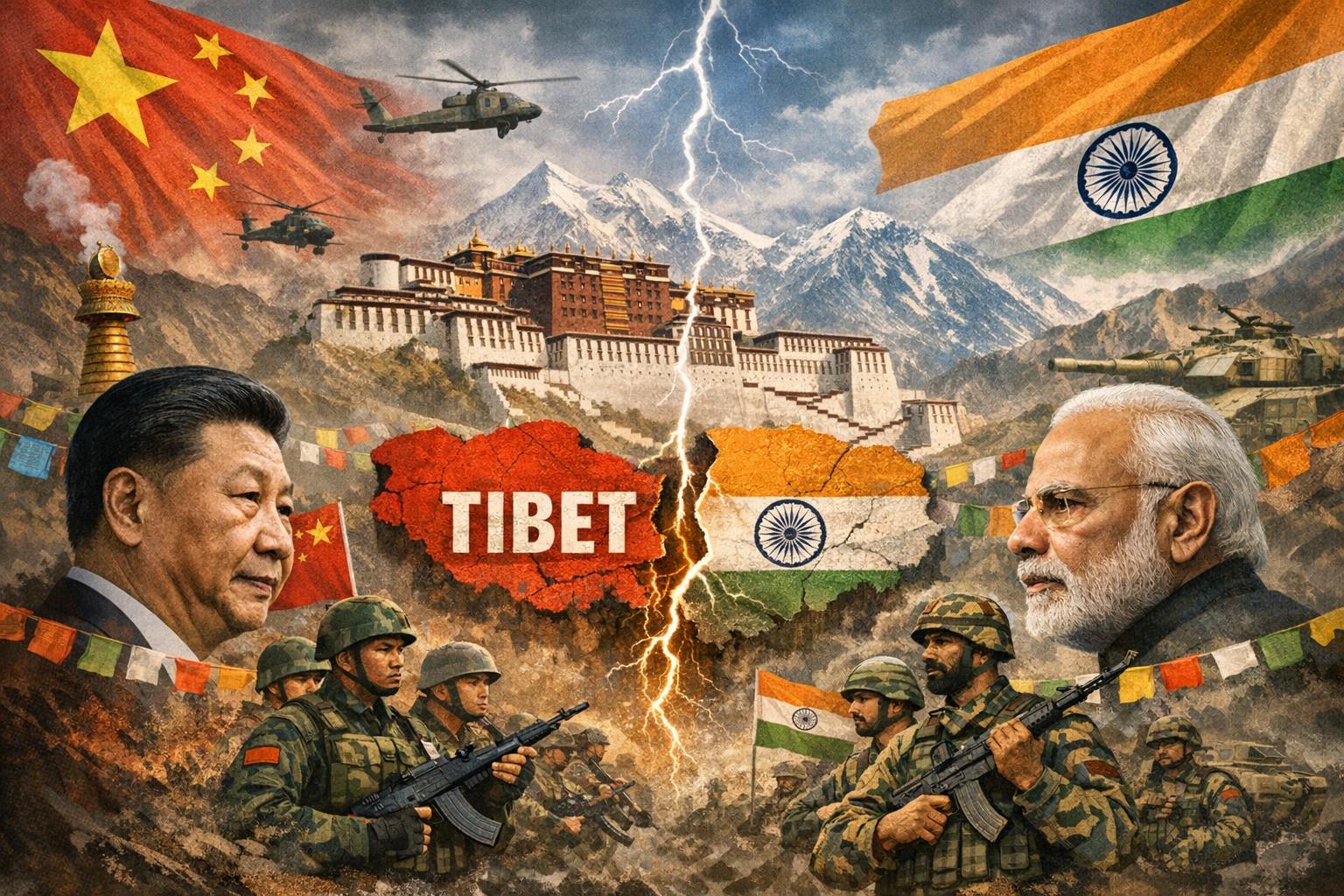
The relationship between China and India in relation to Tibet has developed over centuries and reflects a layered interaction of geography, culture, religion, and state formation. Tibet has historically functioned as a high-altitude buffer zone between the Indian subcontinent and the Chinese heartland. Its position along critical trans-Himalayan routes enabled exchanges in trade, monastic scholarship, and diplomatic contact. Indian religious traditions, particularly Buddhism, flowed into Tibet beginning in the first millennium, shaping Tibetan intellectual and spiritual life. In parallel, successive Chinese dynasties maintained varying degrees of influence over Tibetan political affairs, ranging from symbolic suzerainty to more direct involvement.
During the colonial era, British India engaged Tibet as part of its frontier policy, seeking to secure northern boundaries and limit rival influence. Agreements such as the early twentieth-century conventions attempted to clarify Tibet’s status, though ambiguity persisted regarding sovereignty and autonomy. When India gained independence in 1947 and the People’s Republic of China was established in 1949, both states inherited unresolved questions regarding Tibet’s political position and the alignment of Himalayan borders. These uncertainties laid the groundwork for future disagreements, particularly as both countries moved to consolidate territorial control.
1950s to 1962: An Era of Tension
In 1950, the entry of the People’s Liberation Army into Tibet marked a decisive shift in regional geopolitics. China asserted its authority over the region, and Tibet was formally incorporated into the administrative structure of the People’s Republic of China. For India, this development transformed what had been a relatively distant frontier into a direct boundary with a powerful neighbor. The absence of mutually agreed border demarcations became increasingly significant as both governments began to define and administer frontier areas more actively.
India initially pursued a policy of accommodation, emphasizing diplomatic engagement with China and acknowledging its control over Tibet. However, differences in interpretation of historical boundaries, particularly in the western sector (Aksai Chin) and eastern sector (then known as the North-East Frontier Agency), gradually surfaced. These disputes were compounded by infrastructure developments, including Chinese road construction through contested areas, which heightened Indian security concerns.
The situation intensified in 1959 when a major uprising occurred in Lhasa against Chinese administration. The subsequent flight of the 14th Dalai Lama into India marked a turning point. India’s decision to grant asylum was based on humanitarian and historical considerations but was perceived by China as interference in its internal affairs. This event deepened mistrust and shifted bilateral relations toward confrontation.
Between 1959 and 1962, both countries increased their military presence along contested border areas, adopting forward policies that brought forces into close proximity. Diplomatic efforts failed to resolve underlying disagreements, and in October 1962, open conflict broke out. The Sino-Indian War, though relatively brief, had lasting consequences. China achieved significant territorial gains in some sectors, while a unilateral ceasefire left the border unresolved. The war fundamentally altered perceptions on both sides and established a long period of strategic caution.
Post-1962 Developments
Following the conflict, China and India entered a phase characterized by limited engagement and mutual suspicion. Diplomatic relations were scaled back, and meaningful dialogue on boundary issues was delayed for years. Tibet remained an implicit factor in these dynamics, not only because of geography but due to the continued presence of the Tibetan leadership in exile within India.
From the late 1970s onward, both countries began gradual efforts to normalize relations. High-level visits resumed, and mechanisms were established to manage border tensions. Agreements in the 1990s and early 2000s aimed to maintain peace along the Line of Actual Control, even though the line itself was not formally delineated. These arrangements focused on confidence-building measures, including restrictions on troop deployments and protocols for handling encounters between patrols.
Despite these efforts, the underlying dispute remained unresolved. The border question is closely linked to Tibet because historical claims and administrative boundaries often reference periods when Tibet exercised varying degrees of autonomy. China’s position is tied to its assertion of continuous sovereignty over Tibet, while India’s claims are influenced by colonial-era agreements and its own administrative practices.
The Tibetan government-in-exile, headquartered in Dharamshala, continues to be a sensitive issue in bilateral relations. India officially recognizes Tibet as part of China but allows Tibetan refugees to live and organize within its territory. This dual approach reflects an attempt to balance diplomatic commitments with domestic and humanitarian considerations. China, however, views any political activities by exiled Tibetan groups as a challenge to its authority.
Modern Implications
In recent decades, China and India have both emerged as major economic and political actors, leading to a relationship that combines cooperation with strategic rivalry. Trade between the two countries has expanded significantly, yet border tensions periodically resurface, indicating that underlying issues remain unsettled. Incidents along the Line of Actual Control, including standoffs and localized confrontations, demonstrate the persistent fragility of the situation.
Tibet continues to influence these dynamics in several ways. First, its geographic position makes it central to military infrastructure and border management. Both sides have invested in roads, airfields, and logistics networks in adjacent regions, which affects the strategic balance. Second, water resources originating from the Tibetan plateau are increasingly important, as major rivers flow from this area into both countries. Control over these headwaters introduces additional considerations related to environmental management and long-term resource planning.
Another dimension involves succession and leadership within Tibetan Buddhism, particularly concerning the role of the Dalai Lama. The question of future recognition has potential diplomatic implications, as China and Tibetan exile institutions may adopt different approaches. India’s position in such a scenario will be closely observed, given its hosting of the Tibetan community and its broader relationship with China.
At the same time, both countries have shown interest in maintaining overall stability. Mechanisms for military dialogue, diplomatic consultations, and crisis management have evolved, reflecting a shared interest in preventing escalation. However, these mechanisms operate within a context where trust is limited and historical grievances remain relevant.
Conclusion
The interaction between China and India over Tibet reflects a convergence of historical legacies and contemporary strategic calculations. Tibet’s role as a geographic buffer, a cultural crossroads, and a politically contested region has ensured that it remains central to bilateral relations. Developments in the 1950s and the conflict of 1962 established patterns that continue to shape policy choices and perceptions.
Although both countries have taken steps to manage tensions and expand cooperation, structural issues tied to territory, sovereignty, and historical interpretation persist. Tibet remains an underlying factor in these issues, influencing border negotiations, diplomatic sensitivities, and regional security considerations. The ongoing challenge lies in balancing national interests with mechanisms that reduce the risk of conflict, while acknowledging the enduring influence of historical developments on present-day relations.