
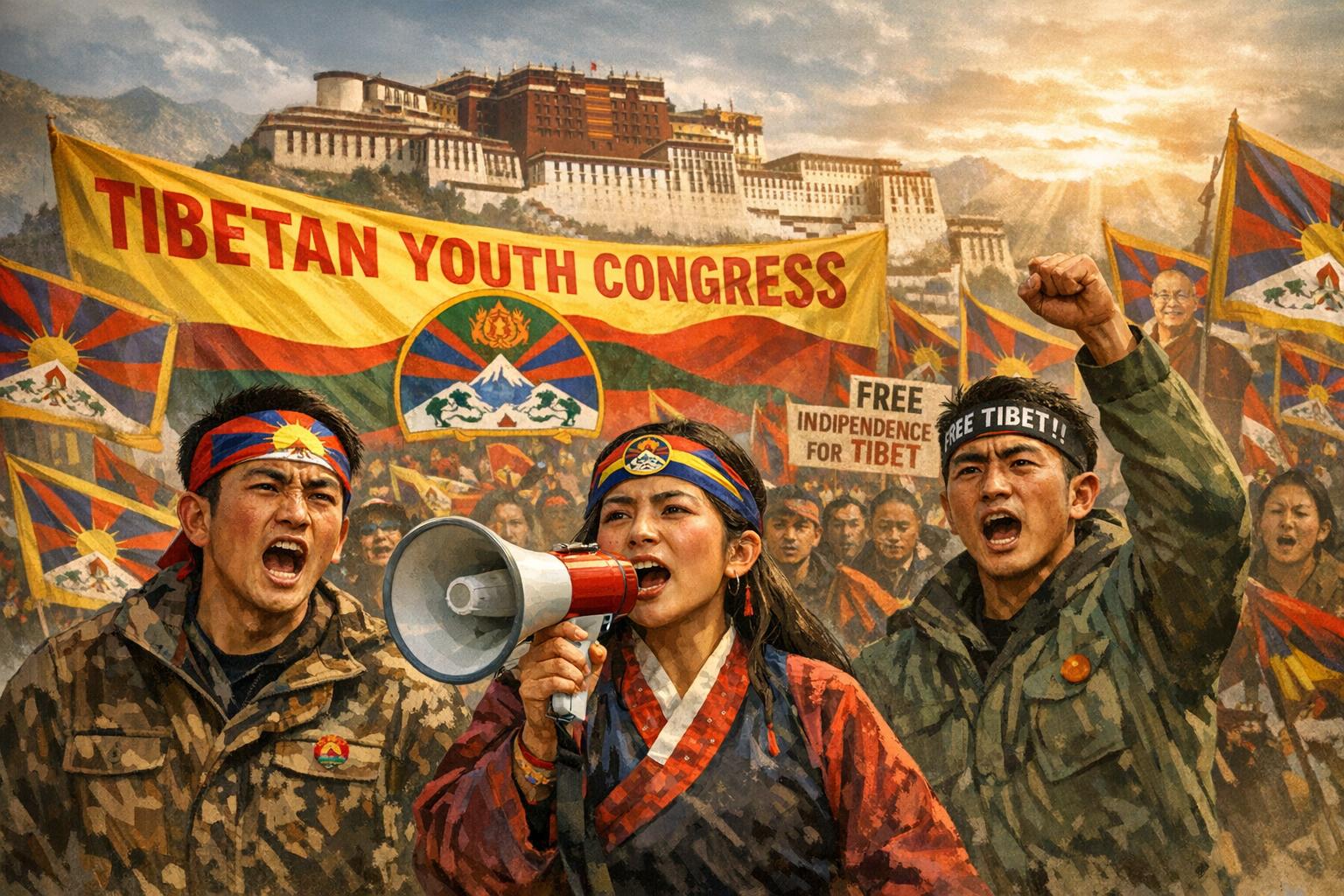
The Tibetan Youth Congress: An Overview
The Tibetan Youth Congress (TYC), founded on October 7, 1970, in Dharamshala, India, is widely regarded as one of the most influential non-governmental organizations advocating for the rights and political future of the Tibetan people. Emerging at a time when the Tibetan diaspora was still consolidating itself in exile, the organization sought to create a structured and dynamic platform through which younger generations could engage with issues of identity, nationhood, and political advocacy. Its formation represented a deliberate effort to ensure that Tibetan youth would not only preserve their heritage but also actively participate in shaping the future of their community.
From its earliest days, the TYC emphasized the importance of self-reliance, civic engagement, and political awareness. It positioned itself as a voice for a generation born either in exile or during a period of significant upheaval, many of whom had not experienced Tibet directly. Through its programs and messaging, the organization has consistently framed youth as central actors in the ongoing discourse surrounding Tibet’s political status and cultural continuity.
Historical Context and Formation
The creation of the Tibetan Youth Congress must be understood within the broader backdrop of the mid-20th century changes in Tibet. Following the incorporation of Tibet into the People’s Republic of China in 1950 and the subsequent 1959 uprising, a large number of Tibetans fled into exile, with India becoming the principal host. Dharamshala, in particular, developed as the administrative and cultural center of the Tibetan diaspora.
By the late 1960s, a need was increasingly felt among younger Tibetans for an organization that would articulate their perspectives more directly. While the Central Tibetan Administration (CTA) provided governance and leadership under the Dalai Lama, youth activists sought a more assertive body dedicated specifically to mobilization and advocacy. The Tibetan Youth Congress was therefore established not merely as a cultural group but as a politically conscious organization.
Its early leadership focused on creating a unified identity among displaced Tibetans. This included fostering awareness of Tibet’s historical status, promoting the Tibetan language, and encouraging participation in political discourse. The organization’s founding conference brought together representatives from various settlements in India, signaling a collective intention to coordinate efforts across geographically dispersed communities.
Objectives and Activities
At its core, the Tibetan Youth Congress maintains a commitment to the goal of Tibet’s independence. This objective distinguishes it from other Tibetan organizations that may advocate alternative political solutions. However, the methods employed by the TYC are primarily rooted in non-violent activism, aligning in part with broader traditions within Tibetan political thought.
The organization’s activities span several domains. Public demonstrations remain one of its most visible methods of engagement, often coinciding with significant dates such as the anniversary of the 1959 uprising. These demonstrations are typically organized in coordination with other advocacy groups and are designed to draw attention to the Tibetan issue in international forums.
Educational initiatives constitute another significant area of work. The TYC conducts workshops, seminars, and awareness campaigns aimed at informing young Tibetans about their history and current political context. These programs often include discussions on international law, human rights frameworks, and the geopolitical dimensions of the Tibet question. By cultivating informed participants, the organization seeks to sustain a long-term movement rather than a short-lived campaign.
Cultural preservation also plays a central role. In exile, maintaining linguistic and cultural continuity presents ongoing challenges. The TYC supports events and programs that reinforce traditional practices, while also adapting them to contemporary contexts. This dual emphasis on preservation and adaptation reflects an understanding that cultural identity must evolve to remain relevant.
Additionally, the organization holds periodic general body meetings and conferences where members deliberate on strategy, leadership, and future directions. These gatherings serve both administrative and symbolic purposes, reinforcing solidarity while allowing for internal debate and renewal.
Global Presence
Although its headquarters remain in Dharamshala, the Tibetan Youth Congress has developed a notable international presence over the decades. Chapters have been established in North America, Europe, and parts of Asia, reflecting the broader dispersion of the Tibetan diaspora. These regional units operate with a degree of autonomy but remain aligned with the central organization’s objectives and principles.
This global network enables the TYC to engage with a diverse range of audiences, including policymakers, academic institutions, and civil society groups. By organizing events in major cities and participating in international forums, the organization contributes to keeping the Tibetan issue visible in global discourse. Its members often collaborate with other advocacy organizations, forming coalitions that address human rights, cultural preservation, and political representation.
The international dimension also introduces complexities. Different national contexts present varying opportunities and constraints for activism. In some countries, public demonstrations and lobbying efforts are relatively straightforward, while in others they require careful navigation of legal and diplomatic considerations. The TYC’s adaptability across these contexts has been a key factor in sustaining its outreach efforts.
Criticism and Challenges
Despite its longstanding role and active membership base, the Tibetan Youth Congress faces a range of criticisms and internal challenges. One of the most prominent concerns relates to its firm stance on full independence for Tibet. This position contrasts with the Middle Way approach advocated by the Dalai Lama and the Central Tibetan Administration, which seeks meaningful autonomy within the framework of the People’s Republic of China. The divergence in these approaches has occasionally led to tensions within the broader Tibetan movement.
Critics argue that advocating for independence may limit opportunities for dialogue with Chinese authorities, while supporters of the TYC’s position contend that it preserves the principle of self-determination. This debate reflects a broader strategic question within exile politics: whether incremental compromise or maximal demands are more effective in achieving long-term goals.
The organization also faces generational challenges. As younger Tibetans grow up in increasingly globalized environments, their connections to traditional forms of activism may differ from those of earlier generations. Sustaining engagement therefore requires continuous adaptation in communication strategies, including the use of digital platforms and new forms of outreach.
Resource constraints and visibility are additional concerns. Operating as a non-governmental organization in exile limits access to funding and institutional support. At the same time, maintaining international attention on Tibet has become more difficult amid shifting geopolitical priorities. The TYC must therefore compete with numerous global issues for media and public attention.
Conclusion: The Tibetan Youth Congress continues to occupy a significant position within the Tibetan exile community and the broader landscape of international advocacy. Its emphasis on youth participation, political engagement, and cultural continuity has allowed it to remain relevant over several decades. While disagreements over strategy and the realities of exile present ongoing challenges, the organization persists in its efforts to articulate and advance the aspirations of Tibetans.