
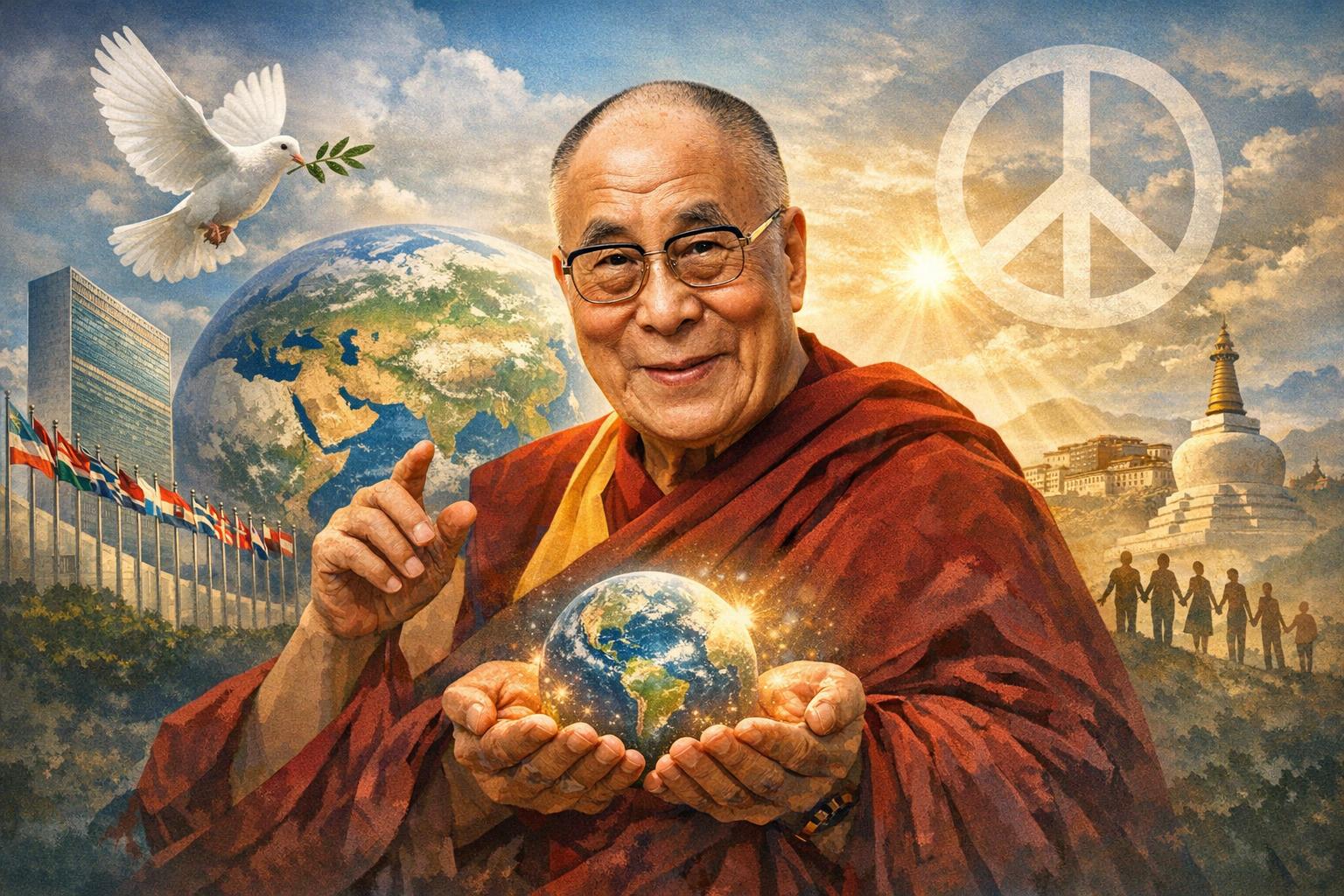
The Dalai Lama’s Influence as a Global Peace Advocate
The Dalai Lama, the spiritual leader of Tibetan Buddhism, has long been recognized as a central figure in advocating for global peace. Known for his teachings of non-violence, compassion, and understanding, he continues to influence discussions on conflict resolution, ethics, and human responsibility across cultural and political boundaries. His role extends beyond religious leadership, positioning him as a global public intellectual whose ideas are engaged in academic, political, and civil society contexts.
Background and Philosophy
The current Dalai Lama, Tenzin Gyatso, assumed the role in 1940 at a young age and later became both a spiritual and temporal leader of Tibet. Following the political upheaval in Tibet and his departure into exile in 1959, his platform broadened significantly, allowing him to address global audiences on issues related to peace and human values.
His philosophical outlook draws on traditional Buddhist teachings while engaging with modern concerns. Central to his approach is the concept of Gandhian non-violence, which prioritizes peaceful resistance and moral persuasion over confrontation. He often frames this philosophy in practical terms, arguing that conflicts rooted in misunderstanding or inequality can be addressed through sustained dialogue and mutual recognition of shared human interests.
The Dalai Lama also promotes the idea that ethical behavior does not require adherence to a specific religion. He frequently emphasizes secular ethics, suggesting that principles like compassion, patience, and tolerance can be cultivated independently of formal religious belief. This inclusive framing has allowed his message to resonate with diverse audiences, including policymakers, scientists, educators, and secular organizations.
Advocacy Efforts
The Dalai Lama’s advocacy for peace encompasses a wide range of activities, from public speeches and international conferences to written works and private dialogues. His publications explore themes such as the relationship between mental well-being and social stability, arguing that inner states of mind influence larger societal conditions.
A consistent element of his advocacy is the emphasis on individual responsibility. He argues that sustainable peace depends not only on institutional frameworks but also on the behavior and attitudes of individuals. In this context, he promotes mental discipline and ethical awareness as foundational elements for peaceful coexistence. These ideas are often presented alongside scientific research, particularly in the fields of psychology and neuroscience, where he has participated in ongoing dialogues with researchers through initiatives such as the Mind and Life Institute.
In global forums, the Dalai Lama frequently introduces the concept of universal responsibility. This principle asserts that individuals and nations alike have an obligation to consider the broader impact of their actions, particularly in an increasingly interconnected world. Issues such as climate change, economic inequality, and conflict are framed not as isolated problems but as shared challenges requiring cooperative responses.
Recognition and Global Impact
The Dalai Lama’s influence as a peace advocate has been acknowledged through numerous international awards and honors. The most prominent of these is the Nobel Peace Prize, awarded in 1989. The Nobel Committee highlighted his consistent opposition to violence and his efforts to seek peaceful solutions to political struggles, particularly in relation to Tibet.
Beyond formal recognition, his impact is evident in the continued relevance of his ideas in global discourse. His writings are widely translated and studied, and his public appearances often attract audiences that span multiple disciplines and sectors. Educational institutions frequently incorporate his perspectives into curricula on ethics, conflict resolution, and global studies.
His contributions also extend to humanitarian and environmental discussions. The Dalai Lama has spoken about the ethical dimensions of environmental stewardship, emphasizing the link between human activity and ecological balance. In this context, peace is framed not solely as the absence of armed conflict but as the presence of stable, just, and sustainable systems.
Educational and Collaborative Initiatives
Education plays a central role in the Dalai Lama’s approach to promoting peace. He has supported the development of programs that integrate emotional awareness, ethical reasoning, and critical thinking into formal education systems. These efforts aim to equip individuals with the skills needed to navigate complex social environments while maintaining constructive and cooperative relationships.
Collaborative engagement is another key aspect of his work. He has participated in interfaith dialogues with leaders from various religious traditions, emphasizing common ethical principles rather than doctrinal differences. These interactions aim to reduce tension between communities and promote mutual understanding.
In addition, his engagement with scientific communities has contributed to interdisciplinary research on topics such as compassion, mindfulness, and cognitive processes. By encouraging collaboration between scientific and philosophical traditions, he has helped create platforms where ideas can be examined through multiple perspectives.
The Dalai Lama also supports initiatives that target younger generations, recognizing that long-term change depends on early education and consistent reinforcement of ethical values. Through lectures at universities, workshops, and public discussions, he continues to address emerging global challenges while maintaining a consistent focus on non-violence and dialogue.
Overall, the Dalai Lama’s influence as a global peace advocate is shaped by a combination of philosophical clarity, practical engagement, and sustained outreach. His work demonstrates how ethical principles can be translated into actionable frameworks for addressing both personal and collective challenges.