
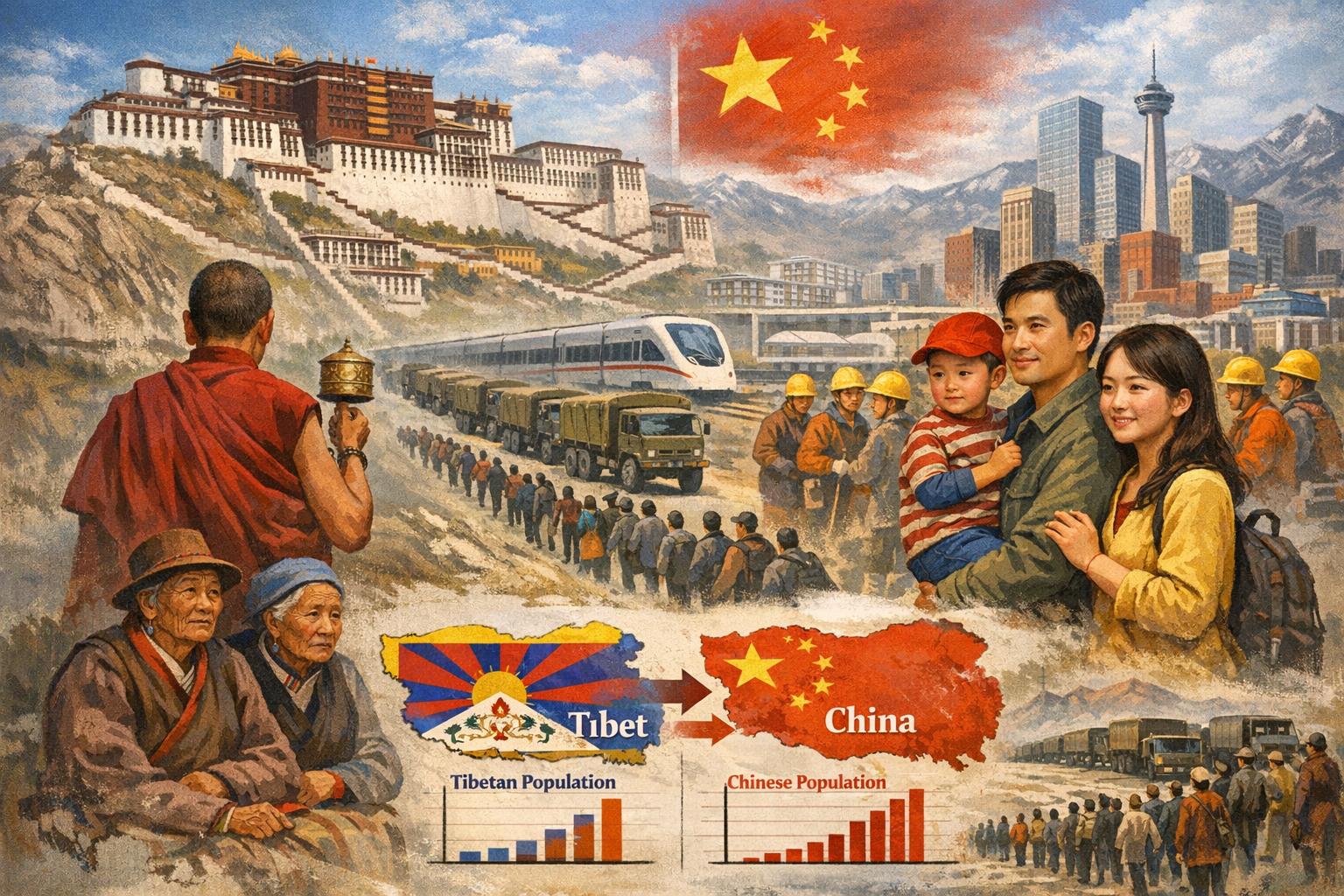
Introduction to Demographic Changes in Tibet
The demographic landscape in Tibet has undergone significant transformations over the past several decades, shaped by a combination of historical developments, state policies, and economic changes. Traditionally, Tibet was overwhelmingly inhabited by ethnic Tibetans, who developed a distinct identity grounded in unique linguistic traditions, religious practices, and cultural norms. For centuries, the region’s geographic isolation helped preserve this demographic consistency.
In more recent history, however, patterns of migration have contributed to a more complex population structure. These shifts are particularly visible in urban centers, where economic development and administrative expansion have altered the composition of local populations. Understanding these changes requires attention not only to migration itself, but also to the broader systems that facilitate and shape it.
Migratory Patterns
The influx of Han Chinese, the largest ethnic group in China, represents one of the most discussed aspects of demographic change in Tibet. Migration into the region has occurred in different waves since the mid-20th century, influenced by political integration, economic expansion, and evolving infrastructure networks. While early movements were often linked to administrative and military presence, later migration has been increasingly driven by market-oriented factors and employment opportunities.
Migration is not uniform across Tibet. Urban areas such as Lhasa have seen more pronounced demographic diversification, while rural regions remain more heavily Tibetan. This uneven distribution reflects differences in access to infrastructure, economic activity, and state investment. Seasonal and temporary migration also plays a role, particularly in sectors such as construction, tourism, and retail.
Government Policies
State policies have been central in shaping demographic trends. The Chinese government has invested heavily in Tibet’s development, aiming to integrate the region more closely with national economic systems. These efforts include large-scale infrastructure projects such as highways, railways, airports, and urban expansion initiatives. The Qinghai–Tibet Railway, for example, has significantly reduced travel time and transportation costs, facilitating both migration and trade.
In addition to physical infrastructure, policy measures have provided incentives for migration. These may include subsidies, job placements, and support for businesses operating in the region. Administrative restructuring and the expansion of public services have also created positions that attract workers from other provinces. These policies are often presented as part of broader goals of modernization and economic development.
Employment Opportunities
Economic growth in Tibet has generated a range of employment opportunities across different sectors. Construction, public administration, tourism, and commerce have expanded in response to increased investment and infrastructure development. These sectors often rely on labor from outside the region, particularly for skilled or technical roles.
Migration is not limited to large-scale enterprises. Small businesses, retail operations, and service industries also attract migrants seeking new markets and economic prospects. In urban areas, this has led to a diversification of economic activity, with new types of goods and services becoming available. For many migrants, Tibet represents a place where emerging markets offer opportunities that may be less accessible in more competitive regions of China.
At the same time, employment patterns can vary significantly between migrant and local populations. Differences in education, language proficiency, and access to networks may influence job distribution and income levels. These variations contribute to ongoing discussions about economic inclusion and opportunity.
Effects on Local Demographics
The increasing presence of non-Tibetan populations has reshaped the demographic profile of many parts of Tibet, particularly in cities. Urban centers now display a more diverse mix of ethnic groups, languages, and cultural practices. This diversification affects not only population statistics but also everyday interactions, institutional structures, and social dynamics.
Population growth in urban areas has been accompanied by changes in housing, public services, and urban planning. New residential developments and commercial districts reflect the needs of a growing and more varied population. These changes can alter traditional patterns of settlement and community organization that were historically characteristic of Tibetan society.
Cultural Impact
Migration has introduced new cultural influences into Tibetan urban life. The increased use of Mandarin Chinese in education, business, and administration reflects broader national trends. In some contexts, this can lead to a reduced presence of the Tibetan language in public and professional settings, particularly among younger generations seeking economic mobility.
Cultural practices are also affected by demographic change. While traditional Tibetan festivals, religious institutions, and customs remain important, their expression may evolve in response to new social environments. The presence of diverse populations can create spaces of cultural exchange, but it can also raise concerns about the preservation of distinct cultural identities.
Observers note that cultural impact is not uniform. Rural areas often maintain stronger continuity with traditional practices, while cities experience more rapid change. The balance between adaptation and preservation continues to be a subject of discussion in academic and policy contexts.
Economic Effects
The economic effects of demographic change are complex and multifaceted. On one hand, migration contributes to economic growth by expanding the labor force, increasing consumption, and supporting the development of new industries. Investment in infrastructure and business has improved connectivity and access to markets, which can benefit the region as a whole.
On the other hand, disparities in economic outcomes can emerge. Questions are sometimes raised about the distribution of wealth, access to employment, and participation in emerging industries. Differences in skills, education, and language proficiency may influence how different groups benefit from economic expansion.
In urban economies, competition for jobs and resources can become more pronounced as populations grow. This can highlight structural inequalities and lead to debates about how development strategies should be designed to ensure broader inclusion. Addressing these concerns requires attention to education, training, and local participation in economic planning.
Social and Urban Transformation
Beyond economics and culture, demographic changes have contributed to broader social transformations. Urbanization has altered patterns of daily life, shifting from traditionally rural and pastoral livelihoods toward more diversified urban occupations. This transition affects family structures, social networks, and community organization.
Public services such as education, healthcare, and transportation have expanded in response to population growth. These developments can improve living standards but also place pressure on existing systems. Managing this balance is an ongoing challenge for regional planners and policymakers.
The interaction between different population groups also shapes social dynamics. In some contexts, increased diversity leads to greater cultural exchange and integration. In others, differences in language, occupation, and background can create social distinctions that influence how communities interact.
Concluding Observations
Understanding demographic changes in Tibet requires a nuanced approach that considers the interaction of government policy, economic opportunity, migration patterns, and cultural dynamics. These factors do not operate independently; rather, they influence each other in ways that shape both short-term developments and long-term trends.
The region’s demographic evolution continues to be monitored and analyzed by researchers, policymakers, and observers. While economic growth and infrastructure development have played a significant role in shaping current conditions, questions about cultural preservation, social equity, and sustainable development remain central to ongoing discussions.
Future changes will likely depend on how policies adapt to emerging challenges and how local and migrant populations navigate an evolving social and economic environment. Continued research and observation are essential for understanding the full implications of these demographic shifts.